Heading to Interclean China: how AI and standards can help the cleaning industry move forward worldwide
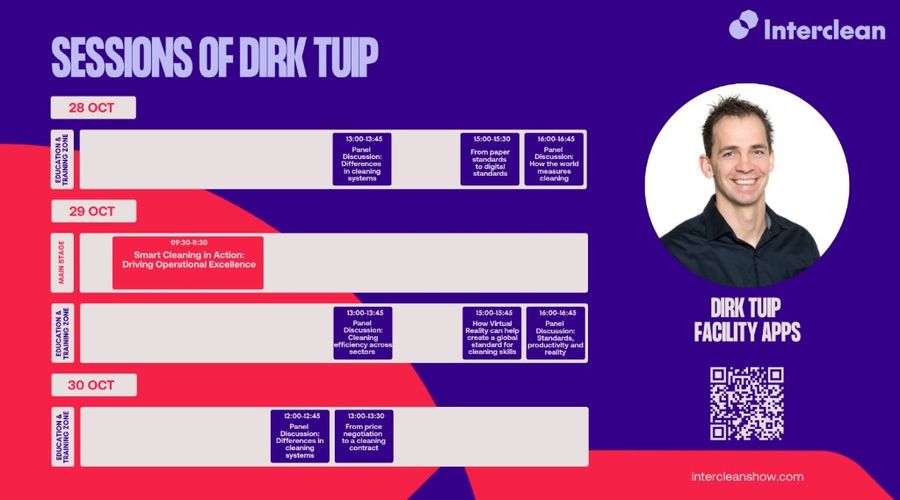

How do we make sure knowledge about good cleaning is not only available, but actually applied? By every cleaner, at every site, regardless of language or country? With that question I leave for Shanghai at the end of October. During Interclean China, from 28 to 30 October, I have been invited as a speaker to give a keynote on AI in the cleaning industry, deliver several presentations and take part in international panel discussions.
In mid-November, FacilityApps will also travel to the ISSA Show in Las Vegas to talk with cleaning companies about what is happening worldwide, how we can respond to global trends and how we can contribute to international cleaning standards for a cleaner world and better support for cleaners on the job.
My contributions cover AI, (digital) standards, virtual reality and better cleaning contracts through calculation. Different topics, with one shared question: how do we make professional cleaning more workable, more transferable and more measurable?
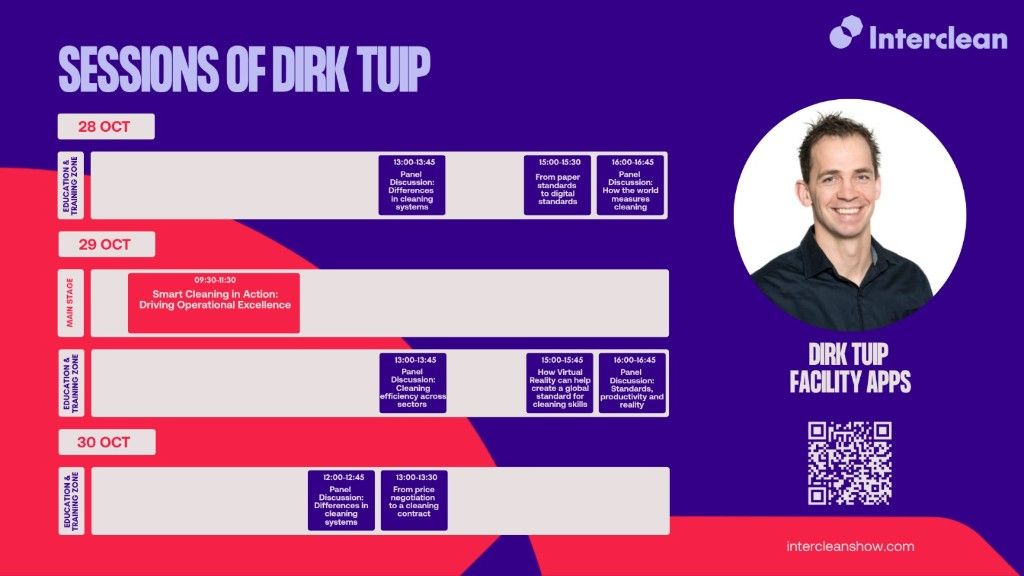
In my keynote, the focus is how AI can help raise the level of cleaning worldwide. AI can make information easier to understand, recognise patterns and support people in their day-to-day decisions. Not only in the office, but especially on the job. The question is not only what AI can do. The question is which knowledge and processes we want to strengthen with it.
From paper to digital standards
The cleaning industry in the Netherlands has had standards for decades. They existed only in paper logbooks, client visit reports and quality forms.
In ‘From Paper Standards to Digital Standards’ I will show how we digitised those existing ways of working in the Netherlands. Not to replace paper with a screen, but to share information, follow up on agreements and make quality visible. That connected information is also an important basis for applying AI in a meaningful way.
Using VR to build a worldwide foundation for skills and cleaner training
What if every cleaner, anywhere in the world, could learn and practise the same professional foundation?
That is what How Virtual Reality Can Help Create a Global Standard for Cleaning Skills is about. With VR Training we can make tasks visible and let people practise, with less dependence on language or on the explanation of an individual trainer. In this way we want to contribute to a shared standard for skills, with room for local requirements and specific work environments.
A better cleaning contract does not start with the price
In From Price Negotiation to a Cleaning Contract I turn the usual conversation around. Not negotiating the price first, but agreeing what needs to be cleaned, to what quality level and how often.
With examples from FA Calculation I show how you then make the required time and cost visible. That helps clients and cleaning companies set realistic expectations and record clear agreements.
I am also going to Shanghai to learn
I am especially curious about how cleaning is done in Asia and in countries such as Australia, Singapore and Japan. How are staff trained? Which quality standards are used? How do companies calculate the time required and how do they translate that into agreements with clients?
That curiosity fits directly with our ambition. With our FacilityApps suite and our investments in VR Training and a calculation module, we want to help set a worldwide standard that further professionalises cleaning.
Then we should not only explain how we do it in the Netherlands. We also need to understand what works well in other countries, where the differences are and which needs exist there. An international standard becomes stronger when it builds on knowledge and practical experience from different parts of the world.
For me, Interclean China in Shanghai is therefore not only a stage to speak from, but also a chance to listen, compare and take new insights home.
Exchanging knowledge internationally
I am looking forward to the panel discussions with, among others, Bill Bassett of The Interclean Group, Kelsey Hargreaves and Neil Spencer-Cook of BICSc, Helge Alt, Nea Backström of MTB Cleaning Services, Karin Perling and others.
They bring different perspectives: from training and professional competence to healthcare cleaning, quality measurement, technology and good employment practice.
I will also take part in panel discussions on international cleaning systems, measuring cleaning, and the relationship between standards, productivity and day-to-day reality.
Technology should make the profession stronger
For me, all of these topics come back to the same ambition.
Clear standards make it plain what good work is. Training helps people carry out that work. A transparent calculation shows the effort required. Digital processes and AI can connect those parts and make the knowledge accessible to more people.
The goal is not more technology in cleaning. The goal is better support for staff, demonstrable quality and realistic agreements with clients.
If we are also willing to learn from each other internationally, we can move the sector forward together.
Are you at Interclean China from 28 to 30 October, or at ISSA in Las Vegas? Let’s meet. View the Interclean China programme
Related posts
How to choose cleaning software for your operation
A decision framework for cleaning operators evaluating cleaning software: scope, integrations, evidence, TCO and rollout risk.
Cleaning operations software for planning, quality and delivery
Cleaning operations software that runs planning, work orders, quality control and reporting for cleaning companies from 20 employees upward.
Best software for cleaning companies: a founder’s view
The best software for cleaning companies is the system that helps your people make reliable decisions across sites, not the one with the longest feature list.